
A Good Problem to Have
Imagine you've owned one or two stocks for many years. Maybe you received shares from an employer as part of your pay, or bought them early and simply held on. Over the years, that stock has grown tremendously. Shares that cost you $50,000 are now worth $1,000,000.
That's wonderful news. But it comes with a few headaches.
First, a huge share of your net worth may now ride on a single company. If that company stumbles, your retirement stumbles with it. Ask anyone who held Enron, Lehman Brothers, Cisco or GE in 2000 or any number of other stocks how quickly "a great company" can become a painful lesson.
Second, you're sitting on a $950,000 capital gain. Sell the stock to diversify, and you could owe tens or even hundreds of thousands in federal and state tax. So many people do nothing. They stay concentrated, hoping the tax problem will somehow solve itself.
This is exactly the situation a product called an exchange fund promises to fix. It sounds terrific. In practice, it's rarely the best answer.
How an Exchange Fund Works
Think of an exchange fund as a big potluck dinner for concentrated stocks.
Dozens or hundreds of investors, each holding one big winner, contribute their shares into a single private partnership. One person brings Microsoft. Another brings Apple. A third brings Nvidia, Amazon, or Google. Because you're contributing your shares to a partnership rather than selling them, the IRS doesn't treat it as a sale. No tax is due.
In return, you own a slice of the whole pot. Instead of one stock, you now hold a small piece of a diversified basket.
There are a few strings attached:
You must stay in for about seven years. That's the holding period required to keep the tax deferral intact.
About 20% of the fund must be in "qualifying" illiquid assets, usually real estate. That's a tax-law requirement, not an investment choice.
Your original cost basis follows you. When you finally leave, you receive a basket of roughly 20 or so different stocks. But all of them carry your old, very low cost basis.
On paper, it's clever: diversification today, with the tax bill pushed years into the future.
Why They're Less Useful Than They Sound
Exchange funds solve a real problem, but they solve it in an expensive, inflexible way. Here's what often gets lost in the sales pitch.
They defer the tax. They don't eliminate it. An exchange fund's whole value is postponing capital gains tax. But if you can plan your sales so the gains are taxed at 0% (more on that below), there's nothing meaningful to postpone. You'd be paying high fees to avoid a tax you might never have owed.
They can push your gains into higher-tax years. Say you join a fund at 62, when you've just retired and your income is low. Seven years later you're 69. By then Social Security has likely started, and required minimum distributions from your IRA are close. Your income is higher. Now you're holding 20 stocks with rock-bottom cost basis, and selling them could cost you 15% or more on gains you might have realized at 0% years earlier.
The costs add up. Newer, tech-driven providers charge management fees near 1% a year on smaller accounts, plus operating expenses. Traditional providers often charge a 1.5% to 2% upfront placement fee, an annual management fee of roughly 0.5% to 0.7%, a servicing fee around 0.25%, and administrative costs on top. Over a seven-year lockup, total costs can easily reach 5% to 8% of the value you contributed.
The lockup hurts most at the start of retirement. Leave before seven years and you generally get your original shares back, often minus a 1% to 2% redemption fee. Some funds don't allow any exit for the first couple of years. Tying up your largest asset just as you begin living off your savings removes flexibility right when you need it most.
The diversification is thinner than it looks. People contribute what they have the biggest gains in, which tends to be large technology companies. So these funds usually track indexes like the S&P 500 or Nasdaq-100. If you contribute Microsoft, you'll likely still own a good chunk of Microsoft, alongside its closest peers. And the required real estate slice is often bought with borrowed money, adding leverage and illiquidity rather than true balance. This all just means that the implied benefit of “diversification” within the exchange fund can also just be a meaningless word hiding true volatility.
What Happened When It Mattered
Because exchange funds are private, long-term performance data is hard to find. One rare exception is Eaton Vance, the pioneer in this space. Its largest funds were big enough to file public reports with the SEC.
Its Belcrest Capital Fund took in about $3.6 billion of contributed stock in 1998 and 1999. Here's how it fared through the financial crisis and recovery:
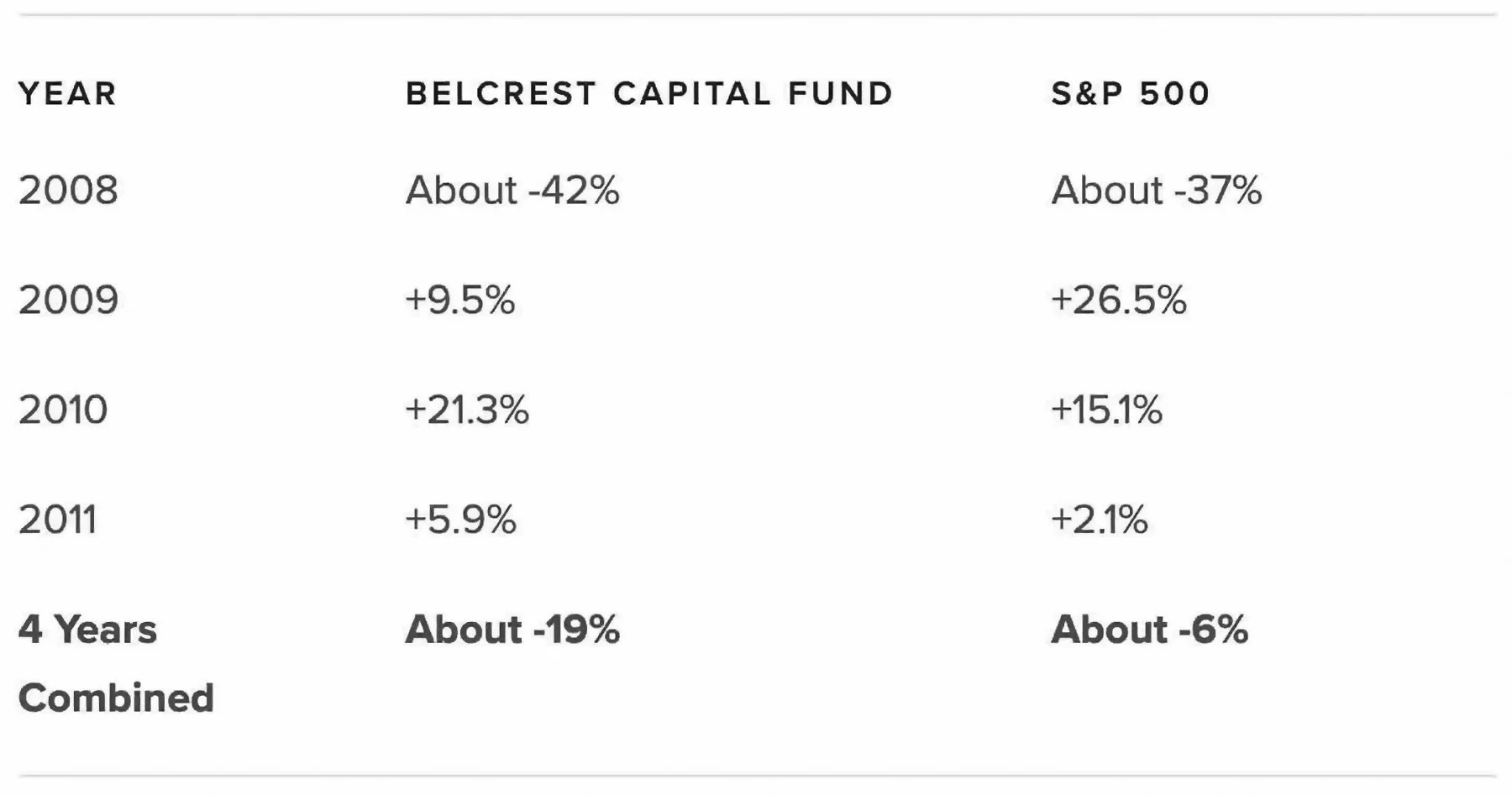
The borrowed money behind the real estate portion magnified the 2008 losses. Fees in 2011 ran about 1.06% of net assets, before interest on that borrowing. By the end of 2011, losses and redemptions had shrunk the fund to about $633 million.
Today's newer funds charge less and track their benchmarks more closely. But the newest platforms only launched in 2023, so none has completed a full seven-year cycle. There's no track record yet for how the exit actually works.
A Better Tool Many People Overlook: The 0% Bracket
Here's something that surprises many people: long-term capital gains can be taxed at 0% federally, if your taxable income is low enough.
For many families, the best window is the first few years of retirement. Paychecks have stopped, but Social Security and required IRA withdrawals haven't started yet. Income can be unusually low, and that's an opportunity.
Using the IRS's estimated 2027 figures for a married couple filing jointly:
The standard deduction is about $34,500.
The 0% capital gains rate applies to taxable income up to roughly $102,800.
Put those together, and if long-term gains were a couple's only income, they could realize roughly $137,000 of gains with no federal income tax. Spouses 65 or older get additional deductions, which stretch that figure even further. In California, where most of our clients reside, state taxes at these income levels are also fairly benign.
And remember, gains aren't the same as sale proceeds. When you sell, the portion that represents your original cost comes back to you tax-free. So the actual cash you can raise each year is larger than the gain itself.
Done year after year, this approach can steadily chip away at a concentrated position. The sale proceeds help fund living expenses, and the portfolio becomes more diversified with each sale. You keep full control, full liquidity, and no seven-year lockup or ongoing fund fees.
A few important cautions:
It takes coordination. Roth conversions, pension income, and health insurance premium tax credits all compete for the same low-income "bracket space." Every dollar converted to a Roth pushes a dollar of gains out of the 0% range. Deciding the right mix each year is where planning earns its keep.
State tax may still apply. California, for example, taxes capital gains as ordinary income. The 0% rate is federal only.
It's not for everyone. If you're still working with a high income, the 0% window may be years away. Other strategies, like charitable gifting of appreciated shares, may fit better in the meantime.
The Bottom Line
Exchange funds are a clever idea with a narrow use. For someone with very high income for the foreseeable future and a truly enormous position, they may have a place. For most families approaching or entering retirement, they're a costly detour.
If you're holding a large, low-basis stock position, the better question usually isn't "How do I avoid the tax?" It's "When is the cheapest time to pay it, and could that cost be zero?" A well-timed, year-by-year plan can often diversify your holdings with little or no federal tax, while keeping your money liquid and under your control.
If you have a concentrated stock position and want to explore what this could look like for you, we'd be glad to run the numbers together.
This article is for educational purposes only and is not individualized tax, legal, or investment advice. Tax figures for 2027 are IRS-based estimates and may change. Please consult your advisor and tax professional before acting on any strategy discussed here.