
What the data actually says about the value of a degree — and why the major matters more than the name on the diploma
Every family with a college-bound kid eventually asks some version of the same question: is this actually worth it? With sticker prices at many private universities now exceeding $90,000 a year, it's a fair question — and one where the honest answer is “it depends,” followed by some specifics that are genuinely useful for planning.
The short version: a bachelor's degree, on average, still pays off handsomely over a lifetime. But averages hide enormous variation, and the biggest driver of that variation isn't how selective the school is — it's what the student studies. That distinction matters a great deal for how we think about saving, borrowing, and choosing a school in a financial plan.
The Headline Numbers
The most rigorous recent work on this question comes from the Foundation for Research on Equal Opportunity (FREOPP), which calculated return on investment (ROI) for roughly 53,000 individual degree and certificate programs — not just schools, but specific majors at specific institutions. Their headline findings:
The median bachelor's degree still delivers a positive lifetime ROI, with a median estimated payoff around $160,000 above what a similar student would have earned with only a high school diploma.
But roughly a quarter to nearly a third of bachelor's degree programs — depending on the vintage of the analysis — show a negative ROI. Those students would have been financially better off skipping college altogether, at least on a purely financial basis.
Fields like engineering, computer science, nursing, and economics routinely produce ROI north of $500,000, and in the best-case programs, several million dollars.
Fields like fine arts, education, and other humanities disciplines frequently show minimal or negative financial returns, even from well-regarded schools.
It's What You Study, Not Just Where
This is the part that surprises people. There's a natural assumption that a more selective, more prestigious school is a safer financial bet. The data doesn't support that as a general rule. A nursing degree from an unselective community college very often produces higher earnings than an art history or music degree from a highly selective private university. The chart below illustrates the general pattern that shows up again and again in this research: quantitative and technical fields cluster at a meaningfully higher return across the entire range of school selectivity, while humanities and arts fields cluster lower — and selectivity alone does little to close that gap.
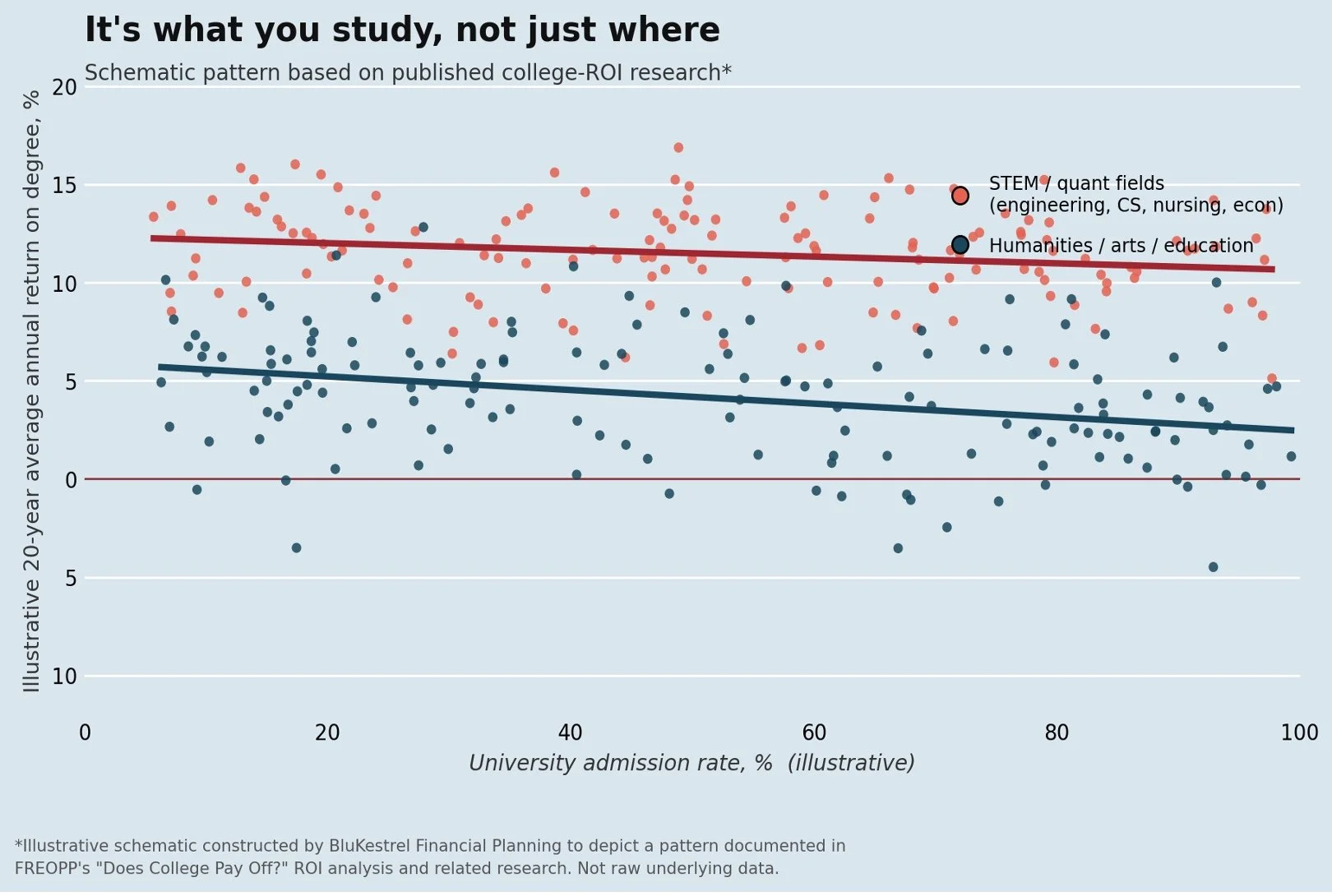
Illustrative schematic constructed to depict a pattern documented in FREOPP's college ROI research — not raw underlying data.
The implication for planning isn't “never study the humanities” — there are non-financial reasons to pursue a field, and plenty of humanities graduates do very well by finding a lucrative path afterward (law, business, consulting). The implication is that the choice of major deserves at least as much financial scrutiny in a family's planning conversation as the choice of school, and arguably more.
Where This Shows Up in a Financial Plan
1.) Debt tolerance should track the major, not just the sticker price
The instinct in a lot of financial plans is to size a family's comfort with student debt around the total borrowed relative to what they can afford to pay — essentially a household balance-sheet question. That's necessary, but it's not sufficient. The more important question is what that debt looks like relative to the graduate's future income, and that number depends heavily on what they study.
A worked example
Say two students each borrow $80,000 over four years — same amount, same 7% blended rate, same standard 10-year repayment term. That works out to a monthly payment of about $930 (roughly $11,150 a year) for both of them. The debt itself is identical. What happens next is not.
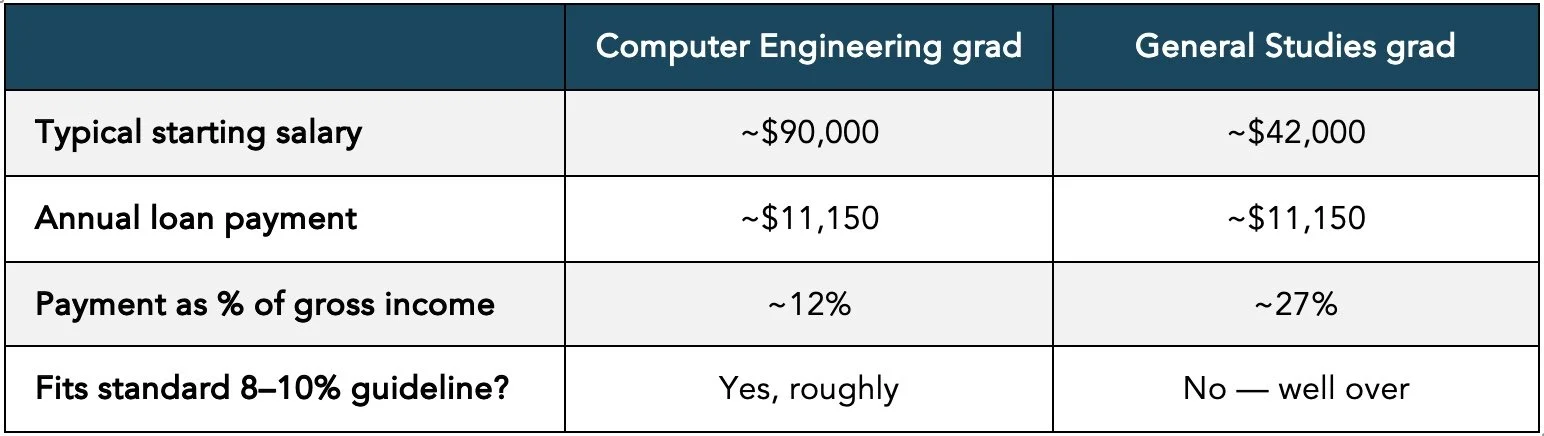
That 27% figure is the problem. Most lenders and financial planners use something like “monthly student debt payments shouldn't exceed roughly 8–10% of gross income” as a rough affordability guideline — similar in spirit to the housing debt-to-income rules we already apply. The engineering grad clears that bar comfortably in year one. The general studies grad doesn't come close, and typically ends up in one of a few places: an income-driven repayment plan that stretches the loan out and adds meaningfully to lifetime interest, reliance on parents to help with payments, or genuine month-to-month cash flow strain right when they're also trying to cover rent, a car, and everything else that comes with starting adult life.
Why this matters for the plan, not just the diagnosis
This isn't an argument against the $80,000 in either case — it's an argument for treating the two scenarios differently before the debt is taken on:
For a student heading into a high-earning, well-defined field, we can generally be more comfortable with heavier borrowing, because the income will absorb it quickly and the family may be better off keeping savings invested rather than draining them to avoid debt.
For a student in a lower-earning or less certain field, the plan should lean harder on funding from savings, cash flow, or a 529 rather than debt, on choosing a lower-cost school for that particular degree, or on structuring a hybrid path (e.g., two years at a community college before transferring) to shrink the total borrowed.
If debt is going to be part of the picture regardless, it's worth stress-testing the actual expected starting salary for that specific field against the payment — not just checking whether the family can theoretically make the payment while the student is still in school.
The point isn't to steer anyone away from a particular major — it's that “$80,000 in debt” isn't one risk, it's two very different risks depending on what's on the diploma, and the plan should reflect that difference explicitly rather than treating all student debt as financially interchangeable.
2.) 529 and other education savings still make sense — the case doesn't rest on elite admissions
Some families hold back on aggressive 529 funding because they're unsure their child will get into a “name” school or they feel as though they lose some element of control of the funds saved. The ROI data actually argues the opposite: since institutional prestige explains relatively little of the financial payoff, a well-funded 529 remains a good bet regardless of which specific school ends up being the right fit. Even if the student does not go anywhere, funds can still be used elsewhere.
A 529 isn't a “use it or lose it” type of account. We have clients with remaining balances left over after qualified educational expenses are covered who simply use those accounts to help fund their own retirements. There are some costs for withdrawing funds for non-qualified expenses — ordinary income tax plus a 10% penalty on the earnings portion — but all in, those costs generally aren't large enough to make a 529 any worse, tax-wise, than the tax liability most clients would face on a typical retirement account, particularly with careful planning.
There's also a cleaner path worth knowing about for leftover balances: under SECURE 2.0, up to $35,000 of unused 529 funds can be rolled over, tax- and penalty-free, directly into the beneficiary's own Roth IRA over their lifetime, subject to annual Roth contribution limits and a handful of other conditions (the 529 account must generally have been open at least 15 years, among other rules). For families who overfund a 529 or whose child ends up needing less than expected, this can turn a leftover education balance into a head start on the child's retirement savings, rather than something that only makes sense to unwind as a non-qualified withdrawal.
3.) Trade and technical certificates deserve a genuine seat at the table
For some kids, a two-year technical certificate in a skilled trade — electrical, HVAC, welding — will outperform many four-year degrees on a cost-adjusted basis, with far less debt and a faster start to earning. This isn't just a consolation prize; for the right student, it's simply the better financial decision. Often, these situations also warrant further scrutiny of the quality of the technical certificate, and especially of the learning and experience gained on the job after the certificate is earned, to assess the potential return on investment.
4.) “Worth it” is a household-specific answer, not a universal one
A family that can pay cash for a humanities degree at a school their child loves is making a very different financial decision than a family borrowing heavily for the same program. Cash flow, existing savings, and the availability of merit aid all change the calculus — which is exactly why this is a planning conversation and not a one-size-fits-all rule.
A Few Caveats Worth Keeping in Mind
ROI studies compare graduates to a counterfactual of not attending college at all — they don't fully capture career pivots, graduate school, or the value of a degree as a credential for jobs that require one regardless of major.
Averages mask wide variation even within a single major: a strong student in a middling program can outperform a struggling student in a strong one.
These studies measure financial return. They don't (and shouldn't try to) put a dollar value on personal fulfillment, intellectual growth, or the non-financial reasons people choose a field of study.
The Bottom Line
College remains, on average, one of the better financial investments a family can make — but “on average” is doing a lot of work in that sentence. The single most useful thing a family can do is treat the choice of major with the same financial seriousness as the choice of school, and to have that conversation before decisions about debt and savings strategy get locked in.
As always, if you'd like to run specific numbers for a child or grandchild — comparing debt scenarios across likely majors, stress-testing a 529 funding plan, or thinking through trade-school alternatives — we're glad to build that out with you.
Sources: Foundation for Research on Equal Opportunity (FREOPP), “Does College Pay Off? A Comprehensive Return on Investment Analysis”; U.S. Department of Education College Scorecard; U.S. Census Bureau American Community Survey.
This material is for educational purposes only and does not constitute individualized investment, tax, or financial planning advice. Please consult your advisor before making education funding or borrowing decisions.